Jay Chadwick
UKC Forum Member
Registered: Jan 2004
Location: IOWA
Posts: 1385 |
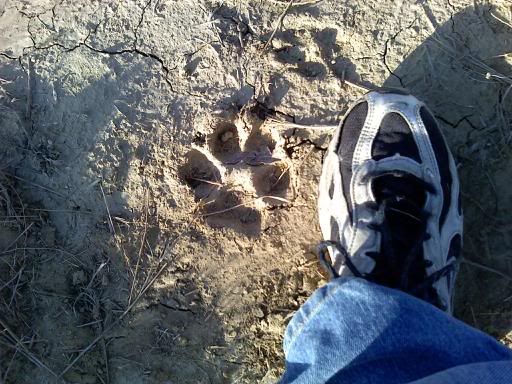
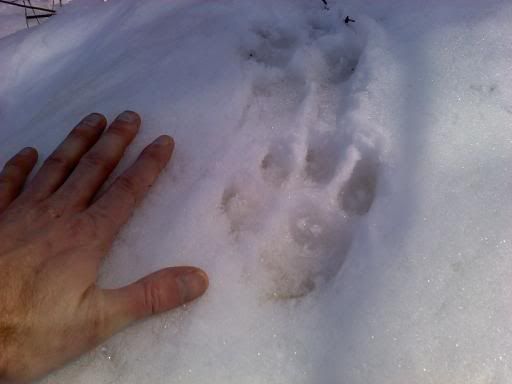
check it out a guy sent this to me from http://www.cougarsanctuary.org/tracks.html
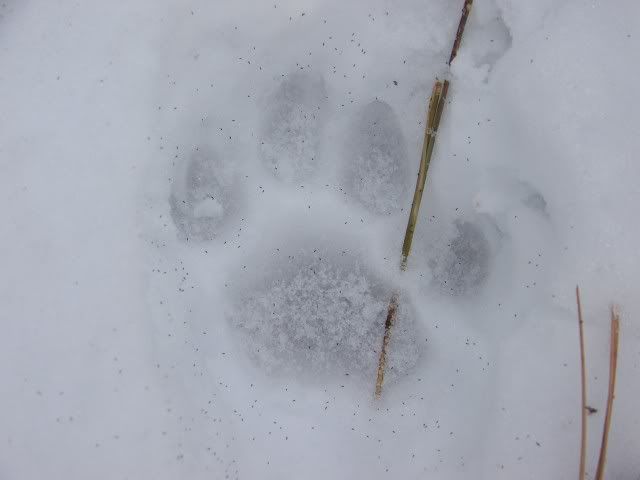
First, look for the overall round shape of the track, common to most felines. The mountain lion’s front foot has four toes and a heel that registers, which means they make an imprint in the ground.
The front foot of the mountain lion is larger and more asymmetrical than the rear foot.
Look at the palm of the track. See how large it looks? It’s almost twice the size of the digits. Canine tracks do not have this characteristic.
Look at the shape of the heel. Notice the dimple in the middle at the top of the pad just under the two middle toes. This is a big tracking identification clue; a classic cat feature.
Look at the space between the toes and the palm pad. There is a curved ridge, which some trackers call a linked ridge. Canines do not have this feature. They have a diamond or pyramid shape in this area of the track.
Let’s look at the toes. The first thing to note is that their shape is oval, and the most striking characteristic is this: the toes are offset. They point in a different direction from the heel pad with one toe ahead or forward of the others.
Notice the outer two toes. One is forward of the other. Dog paws do not have this feature. All of their toes point straight ahead or slightly toward each other.
If you try to draw an X between a mountain lion's toe pads, note that the X crosses into the heel pad. However, if you try to draw an X between a dog’s toe pads, the X doesn’t go into the foot pad. Sometimes you’ll be able to see the claw marks left by a dog’s claws above the toe pads of his print, but these aren’t always obvious.
__________________
"IOWEGIAN SPORTING DOGS - HOME OF FINE HUNTING DOGS SINCE 1989"
Report this post to a moderator | IP: Logged
|





 04-07-2010 12:52 AM